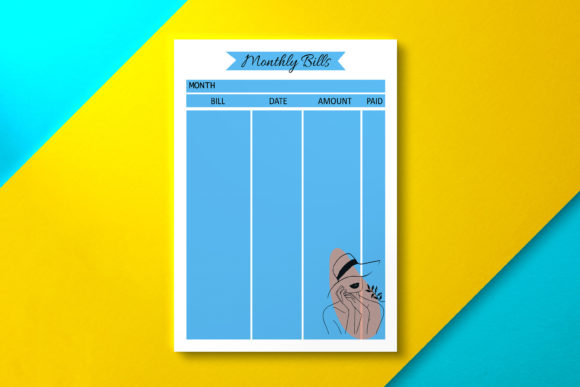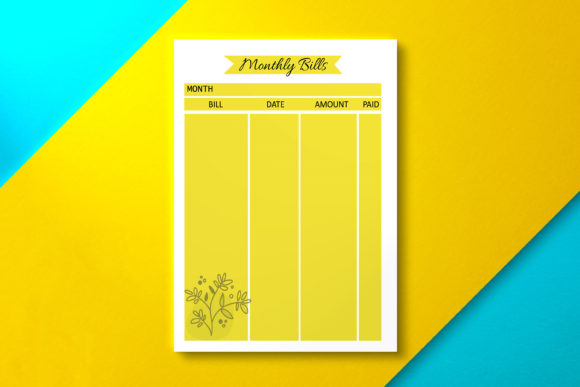
Monthly Bill Yellow: Streamlining Financial Tracking with Color-Coded Organization
In an era where digital fatigue is a genuine concern for professionals and households alike, the resurgence of physical organization systems has taken on new significance. The Monthly Bill Yellow system represents more than just a stationery choice; it is a deliberate intersection of cognitive psychology, practical accounting, and modern publishing standards. For entrepreneurs, freelancers, and business owners managing cash flow, the specific use of yellow-coded billing templates serves as a visual anchor in a sea of white paper and digital notifications. This approach to financial tracking leverages color association to reduce mental load, while the availability of standardized PDF sizes ensures that these tools remain compatible with both traditional filing cabinets and contemporary print-on-demand platforms like KDP.
The relevance of this system lies in its adaptability. Whether you are a creator designing low-content books for passive income or a small business owner seeking a tactile backup for cloud accounting, the Monthly Bill Yellow framework provides a structured yet flexible solution. It addresses the modern need for hybrid workflows where digital convenience meets physical permanence, ensuring that financial records are not only stored but are intuitively retrievable through chromatic categorization.
The Cognitive Advantage of Color-Coded Financial Management
Why yellow? In the spectrum of organizational colors, yellow occupies a unique psychological space. Unlike red, which often signals danger or overdue status, or green, which can imply completion, yellow acts as a high-visibility highlighter for attention without inducing anxiety. When applied to monthly bill tracking, this color creates a distinct category in the user’s mind. For individuals managing multiple revenue streams or expense accounts, separating "yellow" bills from other administrative documents allows for faster processing times and reduced error rates during reconciliation.
This method aligns with current trends in neurodivergent-friendly planning and executive function support. Many professionals and hobbyists find that monochromatic financial documents blend together, leading to overlooked payments or misfiled receipts. By utilizing a dedicated Monthly Bill Yellow template, users create a sensory cue that triggers specific administrative behaviors. This is particularly valuable for freelancers and solopreneurs who must switch rapidly between creative work and back-office management. The color serves as a contextual boundary, signaling a transition into "financial maintenance mode" without the negative emotional weight often associated with bill paying.
Navigating Global Paper Standards: Letter, Half Letter, A4, and A5
A critical aspect of implementing any physical billing system is understanding paper size compatibility, especially for those operating internationally or selling digital products to a global audience. The Monthly Bill Yellow product files address this fragmentation by offering precise formatting across four key dimensions. Understanding these distinctions is essential for both personal utility and commercial viability.
Letter and Half Letter: North American Standards
The standard US Letter size (8.5 x 11 inches) remains the baseline for American business and government correspondence. For users in the United States and Canada, the 1-page Monthly Bill Letter format ensures seamless integration with existing binders, tax folders, and office printers. However, the rise of personal planning communities has popularized the Half Letter size (5.5 x 8.5 inches). This compact format is ideal for mobile professionals, field researchers, and creators who prefer portable record-keeping. The Half Letter variant of the Monthly Bill Yellow system allows users to maintain consistent color coding in a travel-friendly footprint, bridging the gap between desk-based accounting and on-the-go expense tracking.
A4 and A5: International Versatility
For marketers and educators targeting European, Asian, or Australian markets, A4 (210 x 297 mm) is the non-negotiable standard. Providing an A4 version of the Monthly Bill Yellow template eliminates scaling issues that can distort layout integrity when printing. Similarly, the A5 size (148 x 210 mm) mirrors the popularity of Half Letter in international markets, serving as the standard for personal organizers and journals outside North America. By offering these specific variations, the system respects regional preferences and technical requirements, making it a truly versatile tool for global users and digital product sellers.
Commercial Applications and KDP Readiness
Beyond personal organization, the Monthly Bill Yellow system has significant implications for the creator economy. The inclusion of a 50-page Monthly Bill Letter file ready for commercial use transforms this from a simple template into a publishable asset. For authors and designers utilizing Amazon KDP (Kindle Direct Publishing), pre-formatted interiors are the foundation of scalable low-content book creation. However, success in this niche requires adherence to strict technical specifications and market differentiation.
The "Ready KDP upload" designation implies that margins, bleed settings, and resolution have been optimized for print production. This removes the most common barrier to entry for new publishers: formatting errors. More importantly, the yellow color theme offers a branding opportunity. In a marketplace saturated with generic black-and-white ledgers, a color-coded interior can serve as a unique selling proposition. Creators can market these books specifically to demographics that benefit from visual organization, such as students, ADHD entrepreneurs, or visual artists tracking supply costs.
Furthermore, the commercial license attached to these files allows for bundling and repurposing. Digital marketers might include the Monthly Bill Yellow templates as value-add bonuses in financial literacy courses. Business coaches could brand them as part of a client onboarding package. The versatility of the file formats means that a single purchase can support multiple revenue streams, provided the user adds sufficient transformative value to meet platform guidelines and customer expectations.
Integrating Physical Templates into Modern Workflows
While the product files are digital PDFs, their ultimate utility depends on how they integrate into daily routines. The evolution of bill tracking has moved away from pure archival toward active analysis. Modern users do not just want to store a bill; they want to interact with it. The 1-page Monthly Bill layouts across all sizes facilitate this by providing dedicated spaces for notes, payment confirmation, and category tagging directly on the document.
For hybrid workers, this physical template can act as a verification layer for digital systems. After entering data into QuickBooks or Xero, printing a yellow-coded summary or attaching a printed yellow bill tracker to physical receipts creates an audit trail that satisfies both digital efficiency and physical tangibility. This redundancy is increasingly valued by auditors and tax professionals who recognize that software glitches happen and that physical backups provide security.
Educators and financial literacy advocates also find practical application here. Teaching budgeting to young adults or employees often fails when relying solely on abstract apps. A tangible, color-coded Monthly Bill Yellow worksheet makes the concept of recurring expenses concrete. It allows learners to physically sort, highlight, and manipulate their financial obligations, reinforcing learning through kinesthetic engagement. This educational angle expands the potential user base beyond established businesses to include schools, workshops, and community programs.
Practical Recommendations for Implementation
To maximize the effectiveness of the Monthly Bill Yellow system, users should consider the following practical strategies:
- Consistent Printing Protocols: If using the color yellow as a functional signal, ensure your printer settings are calibrated correctly. Faded or inconsistent yellow can undermine the categorization system. For KDP creators, always order a proof copy to verify that the yellow elements print clearly on the chosen paper stock, as color reproduction varies between matte and glossy finishes.
- Digital-Analog Bridging: Use the PDF versions as interactive forms on tablets before printing. Apps like GoodNotes or Notability allow users to fill out the Monthly Bill Yellow template digitally, save a copy, and then print only what is necessary for physical filing. This reduces paper waste while maintaining the organizational structure.
- Version Control for Commercial Users: If modifying the 50-page commercial file for KDP, keep master copies of the original unaltered files. Create separate working files for each variation you produce. This ensures you always have a compliant baseline to return to if platform specifications change.
- Contextual Customization: While the template provides structure, effective use requires personalization. Add specific headers relevant to your industry or household. A freelancer might add "Client Name" and "Project Code" fields, while a household manager might add "Budget Category" and "Payment Method." The template is a starting point, not a constraint.
The Future of Tactile Financial Tools
As we look forward, the demand for specialized, aesthetically functional tools like Monthly Bill Yellow is likely to persist rather than diminish. The saturation of digital finance apps has created a counter-movement valuing intentionality and mindfulness in money management. People are seeking tools that force a pause, encouraging reflection rather than automated detachment. Color-coded, size-specific physical templates satisfy this need by making financial administration a deliberate, visible act.
Moreover, the gig economy and the proliferation of micro-businesses mean that more individuals are responsible for their own bookkeeping than ever before. These users often lack formal accounting training and benefit immensely from intuitive, visually guided systems. The availability of professional-grade, commercially licensed templates democratizes access to organized financial tracking, lowering the barrier to entry for sustainable self-employment.
Ultimately, the Monthly Bill Yellow system exemplifies how traditional concepts can be refined for contemporary needs. It respects the technical realities of global paper standards and digital publishing while addressing the human desire for clarity, color, and control. Whether used as a personal ledger, a teaching aid, or a commercial product, it stands as a testament to the enduring power of well-designed physical tools in an increasingly virtual world. By choosing specific sizes and colors with intention, users and creators alike can transform the mundane task of bill tracking into a streamlined, effective, and even satisfying component of their broader organizational ecosystem.