1000 Sudoku Puzzles with 6 Levels V1: A Complete Resource for Low-Content Publishing
The low-content publishing market has evolved from a niche side hustle into a legitimate business model for creators, educators, and entrepreneurs. Among the various niches available, activity books remain some of the highest-converting products on platforms like Amazon KDP. Specifically, puzzle books offer evergreen demand because they serve a dual purpose: entertainment and cognitive maintenance. However, aspiring publishers often face a significant bottleneck during the production phase. Creating a high-quality interior is time-consuming, technically demanding, and prone to formatting errors. This is where pre-made resources like 1000 Sudoku Puzzles with 6 Levels V1 become essential tools for streamlining the workflow without sacrificing quality.
Understanding the Strategic Value of Pre-Made Interiors
For professionals and business owners entering the print-on-demand space, time is often the most scarce resource. The process of generating unique, valid Sudoku puzzles, verifying their solvability, and formatting them for print can take hundreds of hours. 1000 Sudoku Puzzles with 6 Levels V1 addresses this friction point by providing a ready-to-use foundation. This resource is not merely a collection of grids; it is a structured asset designed to facilitate rapid product development.
The primary value proposition lies in the balance between volume and variety. A successful puzzle book requires enough content to justify the price point—typically over 100 pages—but also needs sufficient difficulty variation to retain user engagement. By offering a comprehensive suite of 1,000 puzzles across six distinct tiers, this package allows creators to produce multiple books from a single source file or create one massive omnibus edition. This flexibility is crucial for testing different market segments without incurring additional production costs.
Detailed Breakdown of Difficulty Tiers
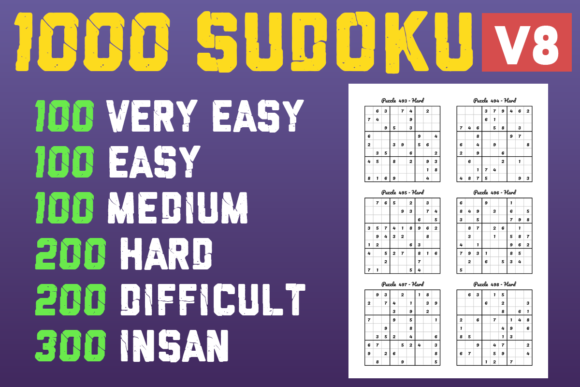
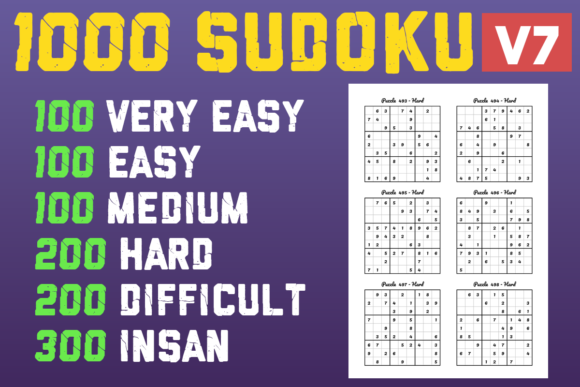
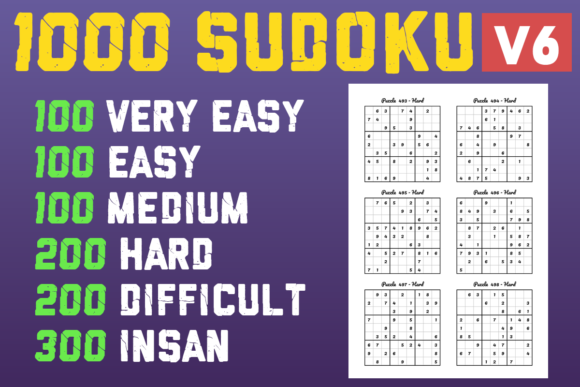
A common mistake in low-content publishing is mislabeling difficulty levels or providing a monotone experience that frustrates users. 1000 Sudoku Puzzles with 6 Levels V1 mitigates this risk through a granular distribution of challenges. Understanding this breakdown is vital for positioning your final product correctly in the marketplace.
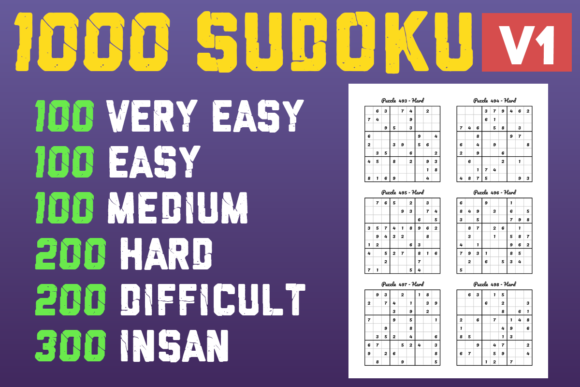
- 100 Very Easy Puzzles: Ideal for children, seniors with cognitive limitations, or absolute beginners. These serve as excellent warm-ups or introductory content.
- 100 Easy Puzzles: Suitable for casual solvers and daily commuters looking for light mental stimulation without frustration.
- 100 Medium Puzzles: The standard baseline for adult puzzle books. These bridge the gap between casual play and serious solving.
- 200 Hard Puzzles: Designed for experienced enthusiasts who understand advanced techniques like naked pairs and X-wings.
- 200 Difficult Puzzles: Targeted at dedicated hobbyists seeking a genuine challenge. These require logical deduction beyond simple scanning.
- 300 Insane Puzzles: The premium tier for experts. Having the largest volume at this level allows for specialized "Extreme" or "Master" editions that command higher perceived value.
This specific distribution acknowledges that the market for extreme puzzles is smaller but more dedicated, while the entry-level market is broader but more saturated. Creators can leverage this mix to build segmented product lines.
Technical Specifications and File Utility
The utility of any digital asset for publishing depends heavily on its format and editability. 1000 Sudoku Puzzles with 6 Levels V1 is delivered in two critical formats: PDF and PPT. While the PDF serves as a proofing tool and a direct upload option for those using standard trim sizes, the PowerPoint (PPT) file is the true engine of customization.
PowerPoint is increasingly favored in the low-content community because it lowers the technical barrier to entry. Unlike Adobe InDesign or Affinity Publisher, which require steep learning curves, PPT allows users to manipulate puzzle placement, adjust margins, add branding, and insert solution pages with familiar tools. This accessibility ensures that even creators with limited graphic design experience can produce professional-grade interiors. Furthermore, having editable source files means you are not locked into a static layout. You can resize grids, change fonts to match your cover aesthetic, or combine puzzles with other activities to create hybrid activity books.
Real-World Applications and Use Cases
Versatility is a key strength of this puzzle collection. Beyond standard trade paperback puzzle books, 1000 Sudoku Puzzles with 6 Levels V1 supports various commercial and non-commercial applications:
- Niche-Specific Books: Create targeted titles such as "Large Print Sudoku for Seniors" using only the Very Easy and Easy tiers, or "Airport Travel Sudoku" focusing on Medium and Hard levels.
- Educational Resources: Teachers and tutors can extract specific puzzles for logic training, math classes, or special education cognitive therapy.
- Care Facility Activities: Nursing homes and rehabilitation centers can print customized weekly activity sheets tailored to residents' varying cognitive abilities.
- Digital Products: Convert the puzzles into printable PDF downloads for Etsy or integrate them into mobile app development projects as placeholder or licensed content.
- Corporate Wellness: HR departments can compile mindfulness booklets for employees, using puzzles as a screen-free break tool.
Evaluating Suitability for Your Publishing Goals
While 1000 Sudoku Puzzles with 6 Levels V1 offers significant advantages, it is important to approach its use strategically. Pre-made interiors are a starting point, not a finish line. To succeed in a competitive market, creators must add unique value. Consider how you will differentiate your book despite using shared assets. Will you focus on superior cover design? Better paper quality? Unique introductions or solving tutorials? Thematic grouping?
Additionally, always verify licensing terms before purchase. Ensure the provider grants full commercial rights for print-on-demand distribution. Some licenses may restrict the number of copies or prohibit using the content in certain formats. Responsible publishing involves respecting intellectual property while leveraging available tools to enhance productivity.
Another consideration is quality assurance. Even professionally generated puzzles should be spot-checked. Test a sample from each difficulty tier to ensure the solving path matches the labeled level. User reviews can quickly destroy a book’s ranking if customers find "Hard" puzzles too easy or "Insane" puzzles unsolvable. Taking an extra hour to validate the content can save months of reputation management later.
Optimizing the User Experience
The organization of your puzzle book matters as much as the puzzles themselves. With 1,000 puzzles at your disposal, structure becomes paramount. Avoid dumping all easy puzzles at the front and insane ones at the back. Instead, consider progressive difficulty within sections or thematic chapters. Include clear instructions, adequate white space for notes, and well-formatted solution pages. The PPT file included with 1000 Sudoku Puzzles with 6 Levels V1 makes these adjustments feasible without redesigning from scratch.
Remember that puzzle books are tactile experiences. Margins should account for binding gutter space, especially for thicker volumes containing hundreds of puzzles. Font size should be legible for your target demographic; what works for a teen audience may be inaccessible to seniors. Customization capabilities allow you to tailor these physical attributes to your specific reader persona.
Moving Forward with Confidence
The journey from concept to published paperback involves many decisions. Choosing the right foundational content is one of the most impactful. 1000 Sudoku Puzzles with 6 Levels V1 provides a robust, scalable solution for creators who want to participate in the lucrative activity book market without getting bogged down in technical production hurdles. By understanding the depth of content, leveraging the editable formats, and applying strategic differentiation, you can transform this resource into a sustainable publishing asset.
Ultimately, success in low-content publishing comes from serving a specific audience exceptionally well. Whether you are creating therapeutic tools for seniors, travel companions for commuters, or brain-training resources for students, having a reliable, comprehensive puzzle library allows you to focus on what matters most: connecting with your readers and delivering genuine value. Start by exploring how these 1,000 puzzles can fit your unique vision, and let the efficiency of pre-made content accelerate your path to publication.