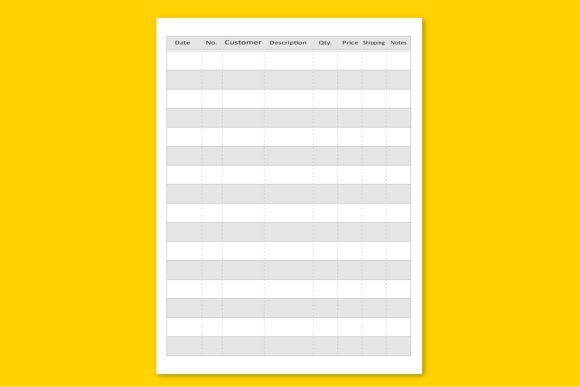
Mastering Business Organization with an Editable Sales Order Log Book Template
In the fast-paced world of small business, freelancing, and e-commerce, organization is not merely a preference; it is the backbone of sustainability. While digital tools and Customer Relationship Management (CRM) software have revolutionized how we track transactions, there remains a significant demand for tangible, reliable record-keeping methods. Enter the Sales Order Log Book, a fundamental tool that bridges the gap between chaotic transaction data and structured financial clarity. For entrepreneurs and self-publishers specifically, the availability of a specialized PDF template sized at 8.5x11 inches, editable in Adobe Illustrator, has transformed this traditional ledger into a customizable asset ready for Amazon KDP upload or internal business use.
Understanding the utility of this specific product requires looking beyond the physical book itself. It represents a convergence of administrative necessity, design flexibility, and publishing opportunity. Whether you are a business owner seeking a branded internal tracker or a low-content publisher looking for high-quality interiors, grasping the nuances of this 120-page editable template is essential for maximizing its value.
The Foundational Purpose of a Sales Order Log
At its core, a sales order log serves as the chronological heartbeat of a commerce-based operation. Before inventory management systems or accounting software existed, businesses relied on these logs to maintain accuracy. Today, despite technological advancements, the log book retains critical significance for several reasons.
First, it acts as a primary source document verification tool. Digital entries can be deleted or altered without a trace, but a physical log provides a linear, unalterable history of transactions when used correctly. Second, it serves as a backup system. Technology fails; servers go down, and internet connections lapse. A physical 8.5x11 inch log book ensures that business continuity is maintained regardless of digital infrastructure status.
For many small business owners, the act of writing down a sale also reinforces memory and attention to detail. This cognitive engagement helps prevent errors that often occur during rapid data entry. The standard letter size (8.5x11 in) is particularly relevant here, as it offers ample horizontal space to record essential data points such as order numbers, customer details, SKU codes, quantities, unit prices, tax, totals, and payment status without cramping handwriting or print readability.
Key Components of an Effective Log Interior
When evaluating a Sales Order Log Book 8.5×11 in – 120 pages, one must understand what makes the interior functional. A generic lined notebook does not suffice for professional tracking. A purpose-built template includes specific columns designed to capture the lifecycle of an order:
- Date and Time: Crucial for fulfilling shipping deadlines and tracking peak sales periods.
- Order Reference Number: Links the physical log to digital invoices or receipts.
- Customer Information: Names and contact details for follow-up or warranty claims.
- Item Description and SKU: Ensures accurate inventory deduction.
- Financial Breakdown: Separate columns for subtotal, tax, shipping, and grand total to simplify end-of-day reconciliation.
- Status Indicators: Checkboxes or spaces for "Paid," "Shipped," "Returned," or "Pending."
This structured approach transforms raw data into actionable business intelligence. When using an editable Adobe Illustrator file, users can adjust these columns to fit their specific niche, whether they are selling handmade crafts, automotive parts, or digital services.
The Advantage of Adobe Illustrator Editability
One of the most significant features of this specific product offering is that it is editable in Adobe Illustrator. This distinguishes it from static PDF templates or locked Word documents. Adobe Illustrator is a vector-based design software, meaning every line, text box, and shape in the 120-page layout is mathematically defined and infinitely adjustable without loss of quality.
For the business user, this editability allows for complete branding integration. You can add your company logo to the header, change the font to match your brand guidelines, or modify column widths to accommodate longer product descriptions. If your business model changes—for example, if you stop charging tax or start tracking international shipping codes—you can update the master template and reprint exactly what you need.
For the creator economy participant, specifically those involved in Amazon KDP (Kindle Direct Publishing), this feature is invaluable. KDP requires precise formatting. Margins, bleed areas, and safe zones must be exact. An AI-editable template ensures that the 8.5x11 inch dimensions are technically perfect. Users can customize the cover concept, alter the interior title page, or even create variations of the log book (e.g., a "Vintage Style" sales log vs. a "Modern Minimalist" version) from a single source file. This drastically reduces production time and technical barriers to entry.
Clarifying Misunderstandings About Physical Logs
A common misconception is that physical log books are obsolete relics reserved for non-tech-savvy individuals. This assumption overlooks the hybrid workflow adopted by many successful modern enterprises. Many businesses use a physical log as a "point of capture" tool at trade shows, pop-up markets, or during packing station workflows where typing is impractical. The data is later batched-entered into digital systems. The physical book acts as a buffer against distraction, keeping staff focused on the immediate task rather than navigating complex software interfaces.
Another misunderstanding relates to the "Ready KDP Upload" designation. Some assume this means the file is automatically uploaded or that no work is required. In reality, this phrase indicates that the file meets the technical specifications for KDP. The user must still create a compliant cover, write metadata, set pricing, and perform the actual upload. The template solves the formatting puzzle, but the entrepreneurial strategy remains the user's responsibility.
Practical Applications in Modern Workflows
The versatility of a 120-page Sales Order Log Book extends across various sectors. Understanding these applications helps potential users visualize how the template fits into their specific context.
For Small Business and Retail
In retail environments, the log book serves as a shift-handover tool. When multiple employees manage sales, a centralized physical log prevents communication gaps regarding special orders, backorders, or customer promises. The 120-page count is strategically chosen; it provides roughly three to four months of daily tracking for a moderate-volume business before requiring archival storage, striking a balance between longevity and portability.
For Freelancers and Service Providers
Service-based professionals often struggle to track billable hours alongside project deliverables. By customizing the editable template, a freelancer can repurpose the "Sales Order" columns into "Project Milestones" or "Service Hours." This adaptability makes the template a cost-effective alternative to purchasing niche-specific planners that may cost significantly more.
For Self-Publishers and Low-Content Creators
For those building a portfolio on Amazon KDP, this template addresses the issue of market saturation. Generic notebooks sell poorly because they lack utility. A professionally formatted, niche-specific Sales Order Log Book targets a high-intent audience: people actively looking to organize their business finances. Because the file is editable in Illustrator, publishers can differentiate their products through unique typography, helpful instructional pages at the front of the book, or specialized appendix sections for yearly summaries.
Best Practices for Utilization and Customization
To derive maximum benefit from this digital asset, users should adhere to several best practices. First, always verify the final output size after editing. While the template is 8.5x11 inches, adding elements near the edge can inadvertently push content into the bleed zone. Always export a test PDF and measure it physically before printing a bulk run or uploading to KDP.
Second, consider the paper type if printing independently. Sales order logs involve frequent erasing and referencing; therefore, selecting a paper weight of at least 70gsm (or 45lb+) is recommended to prevent bleed-through. If using the KDP route, familiarize yourself with their current paper stock limitations for the 8.5x11 trim size to ensure the 120-page spine width calculation is accurate for your cover design.
Finally, leverage the editability to add value. Don't just leave the template as-is. Add a "Notes" section at the bottom of each spread. Include a monthly summary page after every 30 days of logs. Create an index page at the front. These small enhancements, easily achieved in Adobe Illustrator, elevate the product from a simple grid to a comprehensive business management system.
Conclusion
The Sales Order Log Book 8.5×11 in – 120 pages editable template is more than just a digital file; it is a foundational element of business organization and a viable commercial product. By combining the timeless reliability of physical record-keeping with the modern flexibility of vector-based design, it serves two distinct masters: the entrepreneur needing order amidst chaos, and the publisher seeking quality assets for the print-on-demand marketplace.
Whether you are streamlining your own operations or creating resources for others, understanding the depth and utility of this tool is the first step toward success. In an era of digital noise, the structured clarity of a well-designed sales log remains an indispensable anchor for commerce, creativity, and professional growth. Embracing this resource with an informed perspective ensures that every page turned contributes to a more organized, profitable, and sustainable future.