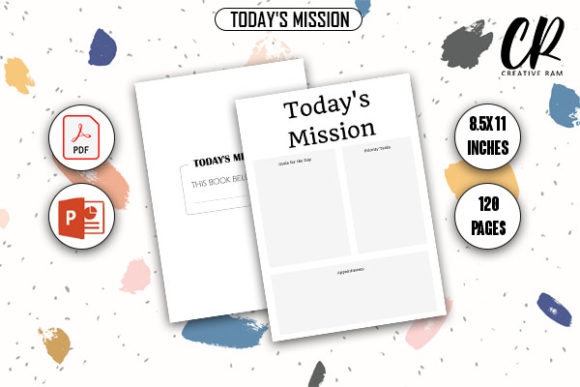
Today s Mission - KDP Interior: Strategic Asset for Low-Content Publishing
Success in the Amazon KDP low-content and medium-content market rarely comes from uploading generic templates. It comes from solving specific problems with precision. Today s Mission - KDP Interior represents a strategic shift away from blank journals toward functional, goal-oriented tools designed for daily execution. This asset is not merely a collection of pages; it is a pre-structured framework intended to help end-users bridge the gap between high-level ambition and daily action. For publishers, entrepreneurs, and creators, understanding the utility of this interior goes beyond simple file management. It requires recognizing how structured planning tools perform in a saturated marketplace and how technical specifications influence both user experience and platform compliance.
The core value proposition of Today s Mission - KDP Interior lies in its specificity. Unlike a standard lined notebook, this interior guides the user through a deliberate process of prioritization. When you offer a product that facilitates clarity, you are selling a result rather than paper. The 8.5″ x 11″ dimension provides ample real estate for detailed task breakdowns, reflection sections, and progress tracking without feeling cramped. This size is particularly effective for professionals and students who require space for mind mapping alongside linear to-do lists. By leveraging a pre-designed 120-page layout with bleed, publishers can ensure a professional finish that meets Amazon’s strict printing guidelines while delivering a product that feels substantial and intentional in the hands of the consumer.
Aligning Product Design with User Psychology
To maximize the potential of Today s Mission - KDP Interior, one must understand the psychological needs of the target demographic. Adults aged 20 to 50, including freelancers, educators, and small business owners, often suffer from decision fatigue. They do not need another place to store information; they need a system to process it. This interior serves as an external executive function, reducing the cognitive load required to plan a day. When selecting or customizing this asset, consider whether the prompts and sections align with actual workflow patterns. Does it allow for time-blocking? Is there space for gratitude or end-of-day review? These features transform a static PDF into a dynamic productivity partner.
Strategic positioning involves matching the interior’s structure to a specific niche. A "Today's Mission" template designed for corporate project managers will differ significantly from one designed for homeschooling parents or fitness coaches. While the source PPTX files allow for customization, the base structure should already resonate with your chosen audience. If you are targeting entrepreneurs, the layout might emphasize revenue-generating activities and delegation. For educators, it might focus on lesson preparation and student engagement metrics. Using the interior without this contextual alignment results in a generic product that fails to convert because it speaks to everyone and no one simultaneously.
Technical Specifications as Quality Indicators
The technical attributes of Today s Mission - KDP Interior are not arbitrary; they are foundational to product viability. The inclusion of bleed is critical for any design where elements extend to the edge of the page. Amazon KDP’s printing process has slight mechanical variances, and designing without bleed risks white borders appearing on trimmed edges, which immediately signals low quality to buyers. The provided print-ready PDF ensures that margins, safe zones, and resolution meet industry standards, eliminating common rejection reasons during the upload process.
Furthermore, the availability of PPTX source files offers a significant operational advantage. In the KDP ecosystem, speed to market matters, but differentiation matters more. Having editable source files allows you to A/B test different covers or interior variations without hiring a designer for every iteration. You can adjust header fonts, modify prompt language, or reorganize sections based on customer feedback or seasonal trends. This flexibility turns a single purchase into a scalable product line. However, this capability demands responsibility. Modifying the template requires maintaining the original design integrity. Altering margins or removing essential safe zones during customization can render the file unusable, negating the benefits of the pre-formatted asset.
Strategic Implementation and Risk Mitigation
Acquiring Today s Mission - KDP Interior is only the first step. The primary risk in the low-content space is saturation through duplication. If multiple sellers upload the exact same unmodified interior, Amazon’s algorithms may eventually suppress duplicate content, or customers may leave negative reviews citing lack of originality. To mitigate this, treat the downloaded files as a foundation rather than a final product. Use the PPTX files to inject unique branding, proprietary methodologies, or niche-specific terminology. Even subtle changes to the introduction page, adding a unique quote bank, or restructuring the weekly review section can create enough distinction to establish intellectual property value and improve discoverability.
Another strategic consideration is the alignment between the interior and your marketing messaging. Your Amazon listing, A+ Content, and external traffic sources must accurately reflect the user experience of the book. If your marketing promises a comprehensive business planning system but the interior only offers basic daily to-do lists, you will generate returns and damage your publisher reputation. Before launching, audit the 120 pages against your sales copy. Ensure that every feature highlighted in your description exists within the book and functions as advertised. Transparency builds trust, and trust drives long-term sales velocity in the KDP algorithm.
Evaluating Long-Term Viability and Customer Experience
Sustainable publishing relies on creating assets that users return to repeatedly. Today s Mission - KDP Interior supports this by encouraging habit formation. When evaluating this asset for your portfolio, consider the longevity of the design. Trends fade, but functional utility endures. Avoid overly decorative elements that distract from usability. Clean, minimalist layouts typically outperform cluttered designs because they remain relevant across different years and seasons. A timeless design reduces the need for frequent updates and allows you to build evergreen listings that accumulate reviews over time.
Customer experience extends beyond the physical book to the perceived value of the purchase. At 120 pages, this interior strikes a balance between portability and capacity. It is thick enough to feel like a serious tool but thin enough to carry daily. When positioning this product, emphasize this practical balance. Highlight how the page count supports a specific duration of use, such as a quarterly sprint or a semester-long academic term. Providing this context helps potential buyers visualize the product in their lives, increasing conversion rates. Additionally, consider creating complementary digital resources or guides that enhance the physical book’s utility, thereby increasing the overall value proposition without altering the core KDP specifications.
Making Informed Decisions Before Upload
Before integrating Today s Mission - KDP Interior into your catalog, conduct a competitive analysis. Search for similar titles and analyze their reviews. What do customers love? Where do existing products fail? Perhaps competitors lack adequate writing space, or their prompts are too vague. Use these insights to customize your PPTX source files, directly addressing market gaps. This data-driven approach transforms a standard template into a superior solution. Remember that the goal is not just to publish, but to solve a problem better than anyone else currently doing so.
Finally, maintain realistic expectations regarding performance. No interior guarantees sales. Success depends on the intersection of product quality, keyword research, cover design, and advertising strategy. Today s Mission - KDP Interior removes the technical barrier to entry and provides a professional-grade foundation, but the strategic execution remains your responsibility. Approach this asset as a component of a broader business strategy rather than a standalone lottery ticket. By focusing on user outcomes, maintaining technical excellence, and continuously refining based on market feedback, you can leverage this interior to build a resilient and profitable publishing portfolio.
- Verify Bleed Settings: Always double-check that your customized PPTX export maintains the correct bleed dimensions before converting to PDF to prevent trimming errors.
- Niche Validation: Confirm that the "Mission" concept aligns with your target audience's specific pain points before investing time in customization.
- Source File Management: Keep master copies of the original PPTX and PDF files separate from your working versions to preserve a clean baseline for future projects.
- User Testing: Print a proof copy to test the writing experience, ensuring paper weight and layout work harmoniously for the intended use case.
- Metadata Alignment: Ensure backend keywords and categories accurately reflect the specific modifications made to the base interior.