2021 Monthly Student Planner: A Technical Asset for Organization and KDP Publishing
The 2021 Monthly Student Planner serves a dual purpose in the modern productivity ecosystem. For end-users, it functions as a structured framework for academic and personal management. For creators, educators, and independent publishers, it represents a production-ready asset designed specifically for Amazon KDP or home printing workflows. Understanding this planner requires looking beyond the calendar pages to examine the technical specifications, layout logic, and integration points that make it a viable tool for both organization and commercial distribution.
This resource is not merely a collection of dates; it is a formatted system tested for print readiness. Whether you are a freelancer managing client deadlines, an educator creating course materials, or a publisher expanding your low-content book catalog, the utility of this planner lies in its precise formatting and comprehensive structure. Downloading your 2021 Monthly Student Planner with pleasure implies acquiring a file set that eliminates technical friction, allowing you to focus immediately on implementation or publication.
Technical Specifications and Print Readiness
For professionals utilizing this planner as a base for KDP publishing or local print shop production, adherence to technical standards is non-negotiable. This asset package addresses common rejection points and quality issues found in self-published planners through specific configuration choices.
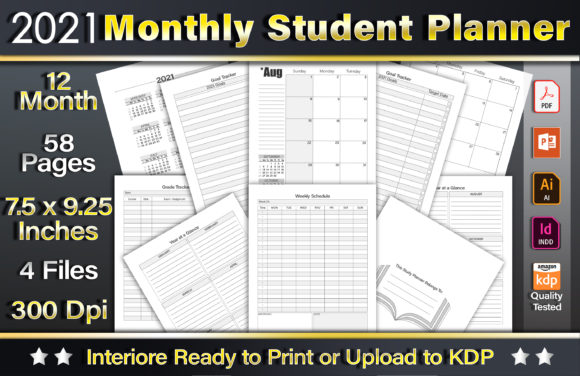
- Dimensions and Bleed Settings: The planner is sized at 7.5 x 9.25 inches with NO BLEED. This specific trim size is optimized for portable academic use while maximizing printable area within standard margin safety zones. The "no bleed" designation ensures that critical content remains well within the safe zone, preventing cropping errors during the binding process at Amazon or third-party printers.
- Resolution and File Integrity: All digital files are provided at 300 DPI high resolution. This is the industry standard for crisp text and sharp lines in print. Low-resolution assets often result in pixelated grids or fuzzy text when printed, which degrades user experience. The included PDF, PPTX, AI, and INDD formats ensure compatibility across different editing environments, from Adobe Creative Cloud to PowerPoint-based customization workflows.
- KDP Testing: The files have been pre-tested for KDP compliance. This includes verification of gutter margins, spine width calculations (if applicable to expanded versions), and color space consistency. For publishers, this reduces the iterative proofing cycle, allowing for faster time-to-market.
Anatomy of the Planning System
Effective planning tools balance structure with flexibility. The 2021 Monthly Student Planner achieves this through a modular layout that supports various organizational methodologies. With 24 total pages allocated specifically for monthly tracking (two pages per month from January 2021 through December 2021), the design prioritizes usability over density.
Monthly Spreads and Reference Integration
Each monthly spread is ruled and dated, providing immediate visual orientation. Crucially, the layout includes blank list space integrated directly into the monthly view. This eliminates the need to flip between a calendar and a separate notebook, keeping task management contextualized within the timeframe. The inclusion of quick reference calendars for the next two months on each spread supports forward-planning workflows. Users can visualize upcoming deadlines and dependencies without losing focus on the current month’s execution.
Supplementary Tracking Modules
Beyond standard calendaring, the planner incorporates specialized tracking pages that serve distinct functional roles:
- Goal Tracker: Facilitates high-level objective setting. This section interacts with the monthly spreads by breaking annual goals into actionable monthly milestones.
- Grade Tracker: Essential for students but adaptable for professionals tracking KPIs, certification scores, or project completion rates. It provides a centralized data point for performance review.
- Weekly Schedule: Offers granular time-blocking capabilities that complement the broader monthly view. This allows users to zoom in from strategic planning to tactical daily execution.
- Year at a Glance: Provides macro-level visibility for long-term project mapping and holiday awareness.
Workflow Integration for Diverse Users
The versatility of the 2021 Monthly Student Planner extends across multiple user personas. Its value proposition shifts depending on whether it is used as a personal productivity tool or a commercial product.
For Educators and Academic Professionals
Educators can utilize this planner as a master template for course syllabi or student handouts. The editable source files (PPTX, AI, INDD) allow instructors to customize the "This Book Belongs To" page with course information or institutional branding. The grade tracker and weekly schedule sections align naturally with semester rhythms, making it an effective supplementary resource for student success initiatives. By providing students with a pre-structured planning tool, educators reduce the cognitive load associated with self-organization.
For Publishers and Content Creators
For those in the low-content publishing niche, this planner represents a foundational asset. The inclusion of multiple file formats enables significant differentiation. A creator might use the INDD file to adjust typography for a premium edition, or the PPTX file to quickly swap out cover art for seasonal variations. Because the interior is already formatted and tested, the workflow shifts from design to marketing and keyword optimization. The 2021 date specificity makes this ideal for archival products, historical planning resources, or bundle offerings where past-year planners provide comparative data or nostalgia value.
For Freelancers and Remote Workers
While labeled a "student" planner, the structure supports freelance project management effectively. The goal tracker functions as a quarterly OKR sheet, while the monthly lists serve as sprint backlogs. The 7.5 x 9.25 inch size is particularly advantageous for remote workers who need a physical planning companion that fits in laptop bags or alongside keyboards without dominating desk space. The analog nature of the planner also provides a necessary disconnect from digital notification cycles during planning sessions.
Implementation and Customization Best Practices
To maximize the utility of this planner, users should approach implementation with intentionality. Simply downloading the file is the first step; integrating it into a workflow requires preparation.
Pre-Print Quality Control
If printing at home or via a local shop, always run a single-page test print first. Verify that the 7.5 x 9.25 dimensions match your paper stock settings exactly. Check the contrast of the ruled lines; some home printers may require adjusting the grayscale output to prevent lines from appearing too faint or too dark. For KDP uploads, utilize the previewer tool one final time even with pre-tested files, as platform updates can occasionally shift rendering.
Digital Adaptation Strategies
Users preferring digital planning can import the high-resolution PDF into tablet annotation apps. The lack of bleed and clean margins make this file exceptionally compatible with platforms like GoodNotes or Notability. Hyperlinking can be added in the PPTX or INDD source files before export, transforming the static planner into a navigable digital dashboard. This hybrid approach allows users to leverage the professional layout while maintaining digital searchability and backup capabilities.
Customization for Niche Markets
Publishers looking to repurpose this asset should consider niche adaptation. The editable files allow for replacing generic headers with industry-specific terminology. A real estate agent could rebrand the "Grade Tracker" as a "Listing Pipeline," while a fitness coach might convert it to a "Client Progress Log." The underlying grid structure remains valid across contexts, but semantic customization increases perceived value and market relevance. Always ensure that any modifications maintain the original 300 DPI resolution and safe zone margins to preserve print integrity.
Long-Term Value and Asset Management
Acquiring the 2021 Monthly Student Planner is an exercise in asset management. For personal users, it provides a historical record of a specific year's activities, useful for retrospective reviews and pattern recognition in personal productivity. For business users, it is a reusable template foundation. The skills gained from customizing and deploying this planner transfer directly to future projects.
The combination of ready-to-upload status and editable source files creates a spectrum of utility. You can deploy it immediately as-is for quick needs, or invest time in tailoring it for specific audiences. This flexibility is what distinguishes a professional-grade planning asset from a simple calendar download. By understanding the technical parameters and workflow applications detailed above, you ensure that the planner serves as an active component of your organizational or business system rather than a passive document.
Whether you are organizing your own academic year, managing a publishing portfolio, or seeking a reliable template for client work, this planner delivers structured functionality. The integration of goal tracking, grade monitoring, and monthly scheduling within a print-optimized format demonstrates a thoughtful approach to physical planning tools. Download your 2021 Monthly Student Planner with pleasure, knowing that the underlying architecture supports both immediate use and long-term adaptation.